Unit 2: Digital Media Theories
UNIT-2
Digital media: Concept and theories of Virtual Identity

Virtual identity is the curated, digital persona (avatars, profiles, posts) an individual constructs and presents on social media and virtual platforms, acting as an interface between their real-world self and others. It allows for free, experimental self-expression and identity exploration, often highlighting desirable traits or ideal selves while enabling control over how one is perceived.
- Self-Presentation
and Curation: Individuals carefully manage their digital
footprints, selecting content to present a desirable image. This often
involves creating an "ideal self" that differs from the actual
self, enhanced by filters and curated content.
- The
"Proteus Effect" and Avatars: Users often shape their
identities through avatars, with online actions and behaviour being
influenced by the chosen avatar's characteristics.
- Fluidity
and Multiplicity: Unlike real-life identity, virtual identity is
not fixed. It is constructed and changed, sometimes daily or every time a
user logs on, allowing for role-playing and exploration.
- Digital
Dissatisfaction/Escapism: Virtual identity can emerge from
dissatisfaction with real-life identity or an identification crisis. It
acts as an outlet for emotional needs not met in the real world.
- Social
Digital Identity Theory: This perspective highlights how digital
identities are shaped by both online and offline group memberships.
Theories
Performing identity and performance- Erving GoffmanErving Goffman’s concept of identity as performance (1959) suggests that people construct and present identities through social interactions. In online environments, this process becomes even more pronounced because users operate with heightened self-awareness and control over how they present themselves (boyd & Heer, 2006). Social networking sites provide mediated and disembodied spaces where individuals can deliberately shape and display alternative performances of the self (boyd, 2006).
Goffman used a theatrical metaphor to explain social interaction, distinguishing between front-stage and back-stage performances. The front-stage is the public space where individuals consciously perform roles and follow social expectations while being observed by others. In contrast, the back-stage is a private area where individuals relax these performances and express themselves more freely.
Multiple Selves Online – Sherry Turkle
Sherry Turkle, in works such as Life on the Screen: Identity in the Age of the Internet (1995), argues that the internet allows individuals to experiment with multiple identities or “selves.” she explains that digital environments such as chat rooms, forums, and virtual worlds enable users to create and manage different identities through usernames, profiles, and avatars. Because online interaction is not limited by physical appearance, location, or social expectations, individuals can explore different aspects of their personality, experiment with gender, roles, or behaviours, and present themselves differently to different audiences.
Turkle suggests that this leads to a decentered or fragmented sense of identity, where a person may maintain several personas simultaneously across different platforms and communities. These multiple identities do not necessarily replace the real self but instead become part of an ongoing process of identity exploration and self-reflection. Online spaces therefore, function as laboratories for experimenting with the self, where individuals can test new ways of being, negotiate their social identities, and better understand their offline selves. Turkle views this multiplicity as a key feature of digital culture, showing how the internet transforms identity from something stable and singular into something dynamic, shifting, and continuously constructed through interaction.
Performativity in Digital Spaces - Butler
Judith Butler’s concept of performativity, developed in works such as Gender Trouble: Feminism and the Subversion of Identity, suggests that identity, especially gender, is not a fixed or natural trait but is produced through repeated actions, behaviors, and social performances. Applied to digital spaces, performativity explains how identities are continuously constructed through online practices such as posting, commenting, sharing images, choosing profile pictures, and interacting with others on social media platforms.
In these environments, individuals repeatedly perform certain roles, styles, and expressions that gradually shape how their identity is perceived by others and by themselves. Digital platforms amplify this process because users can carefully curate their self-presentation, selecting what aspects of themselves to display while omitting others. Through repeated digital interactions likes, captions, hashtags, and visual representations, identities such as gender, lifestyle, or personality are reinforced and normalized. Butler’s idea highlights that online identity is not simply expressed but actively produced and maintained through repeated digital performances, showing that social media platforms function as spaces where identities are constantly negotiated, reinforced, and sometimes challenged.
Conclusion
Virtual identity acts as a curated, often idealized
extension of the self, enabling creative expression and community building
while introducing risks of disinhibition, addiction, and fragmented reality. It
acts as an interface between real-world individuals and digital environments,
where curated profiles may not accurately reflect true character, yet offer
immense opportunities for professional and social networking. As digital and
physical lives become increasingly integrated, maintaining awareness of this
distinction is crucial to prevent the loss of real-world authenticity.
Social and Parasocial media
Social media refers to digital platforms that enable interactive communication and reciprocal relationships between users. On these platforms, individuals create profiles, share content, and directly engage with others through comments, messages, likes, and collaborations. Communication is generally two-way and participatory, allowing users to build communities, maintain friendships, and exchange ideas.
Parasocial media, on the other hand, involves one-sided relationships where audiences feel emotionally connected to media personalities who do not personally know them. The concept originates from the theory of parasocial interaction, introduced by Donald Horton and R. Richard Wohl in 1956. In parasocial relationships, audiences repeatedly watch or follow creators and begin to feel familiarity, intimacy, or friendship with them, even though the interaction is largely unidirectional. This commonly occurs with influencers, celebrities, streamers, and YouTubers on platforms such as YouTube and Instagram, where followers consume content regularly but receive little or no personal response.
Impact of Parasocial Relationships
1. Emotional Connection and Support
Audiences may feel comfort, companionship, or motivation from creators they follow regularly. For some people, especially those who feel isolated, parasocial relationships can provide a sense of belonging.
2. Influence on Attitudes and Behavior
Influencers can strongly shape audience opinions, lifestyle choices, and purchasing decisions. Followers may adopt similar fashion, beliefs, or habits because they trust the creator.
3. Consumer and Marketing Effects
Brands often collaborate with influencers because parasocial bonds increase audience trust, making followers more likely to buy recommended products.
4. Unrealistic Expectations and Dependency
Strong parasocial attachment can sometimes create unrealistic perceptions of intimacy, where audiences feel overly invested in a creator’s life or expect personal attention.
5. Identity and Social Learning
Audiences may learn social norms, values, or identity expressions from the personalities they follow, which can influence how they see themselves and interact with others.
Computer-mediated communication and theories of digital media

Computer-mediated communication (CMC) refers to human
communication that occurs through the use of mobile phones, computers, networks,
and other digital devices. It facilitates both synchronous (real-time, e.g., video
calls) and asynchronous (delayed, e.g., email) interaction, enabling
collaboration and communication across different locations and time zones
Key Features:
- Multimodal Expression: Audio recordings, text-based messaging, video streams, and rich multimedia content enabled fivers form of communication
- Asynchronous and Synchronous Communication – CMC can happen synchronously (in real time, such as live chats or video calls) or asynchronously (time-delayed communication such as emails, forum posts, or messages).
- Interactivity and Participation – Users can actively respond, share, comment, and collaborate, making communication more participatory compared to traditional one-way media.
Network Theory
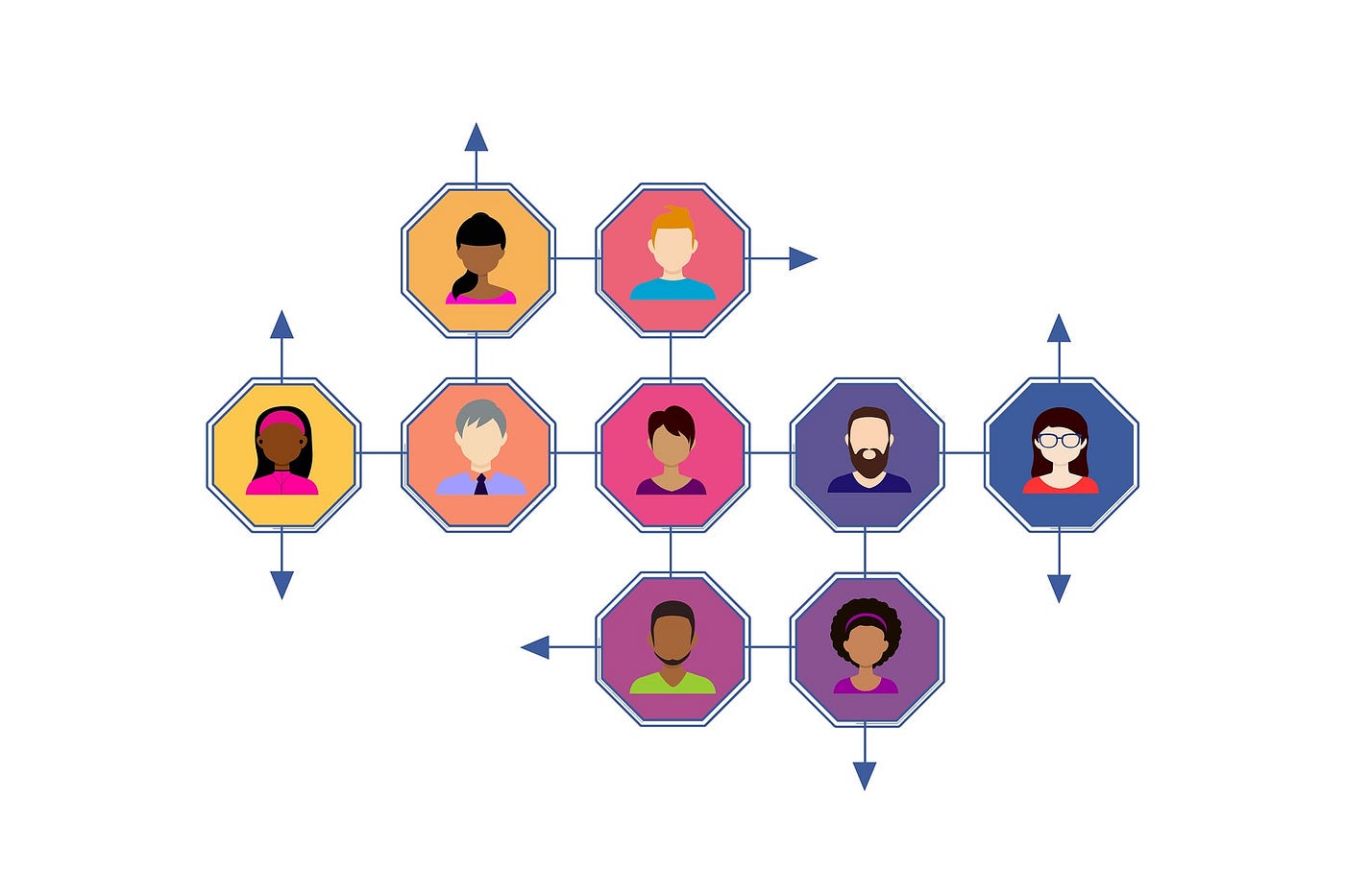
Network Theory says that to understand digital connections, you shouldn’t just look at individual users or devices, but at how they are linked together. In any online platform like Facebook or X, each person is a “node” and their interactions (follows, messages, shares) are the “connections.” The theory explains that the pattern of these connections determines how things happen online like how quickly information spreads, why some people become very influential, and why certain groups form with similar opinions. It also shows that even large digital networks are tightly connected, so ideas, trends, or misinformation can travel very fast from one person to many others. In short, network theory helps us understand that the structure of connections in a digital system shapes how communication, influence, and information flow work.
Nodes = individual entities (users, organisations, groups, devices, websites)
Edges/links = connections between them (friendships, follows, data exchange)
Network theory shows that how connections are affects everything:
-
Dense networks (many connections) → faster information spread
-
Sparse networks → slower, more fragmented communication
Network Society
Network society is the set of social, political, economic, and cultural changes brought about by the widespread use of networked digital information and communication technologies.
The intellectual origins of the idea can be traced back to the work of early social theorists such as Georg Simmel who analyzed the effect of modernization and industrial capitalism on complex patterns of affiliation, organization, production and experience.
Manuel Castells defines the network society as a new social structure emerging from advances in information and communication technologies. It represents a shift from industrial production to a knowledge economy, where information flows across global networks.
Key concepts include:
Space of Flows: The technological ability to engage in activities across distances without physical proximity. Functions like financial markets and media networks operate within this space.
Timeless Time: A condition where traditional sequences of social time are disrupted, allowing for asynchronous interactions and random disturbances.
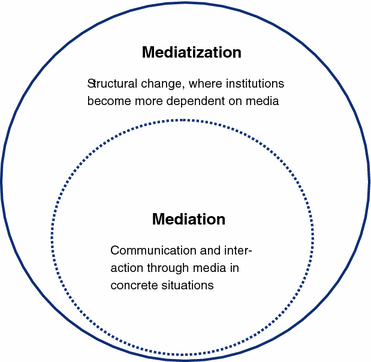
Mediatisation theory
Actor network theory

Actor-Network Theory (ANT) is a theoretical framework and method, pioneered by Bruno Latour, John Law, and Michel Callon, that treats social and technical worlds as interconnected networks of human and non-human actors. It argues that social life is not just human action, but an accumulation of associations involving people, objects, ideas, and technologies (actants)
Digital Media and Participatory Culture: Public Sphere.
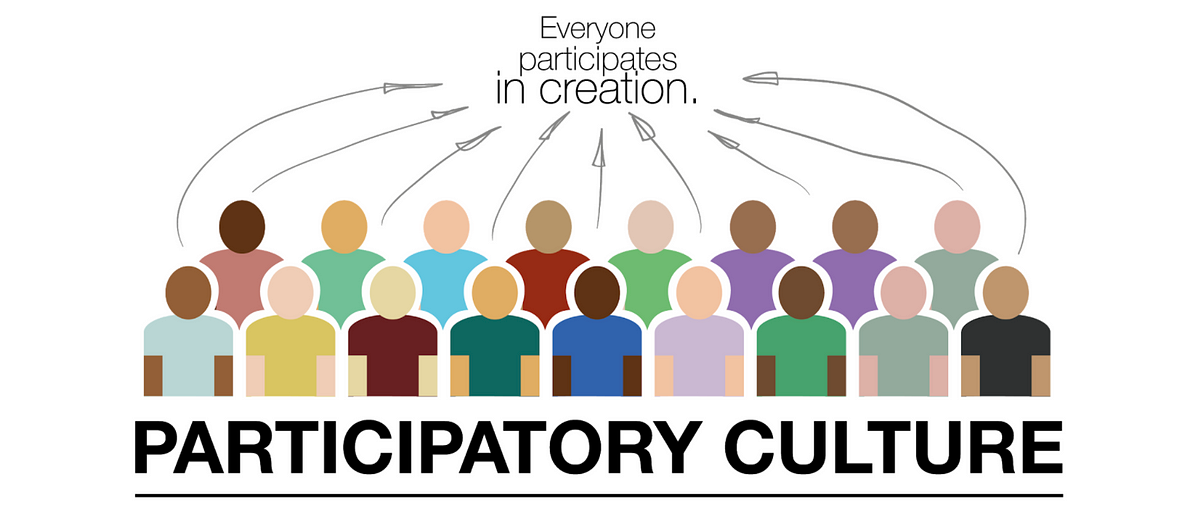
Participatory culture, an opposing concept to consumer culture, is a culture in which private individuals (the public) do not act as consumers only, but also as contributors or producers (prosumers). The term is most often applied to the production or creation of some type of published media.
Digital media has transformed the public sphere into a virtual space, facilitating a participatory culture where individuals act as both creators and consumers, breaking the passive role of audiences. This shift enables widespread engagement in political discourse, social activism, and cultural production through platforms like social media. However, this new landscape faces challenges from corporate control of platforms and the creation of echo chambers.
Transformation of the Public Sphere: The traditional public sphere has shifted from physical spaces to virtual platforms, allowing for broader, more inclusive participation where citizens exchange views, form opinions, and engage in civic discourse.
Participatory Culture: This represents an opposition to consumer culture, where users have a vested interest in the content being produced and take an active role as creators of media, sharing and creating content through online communities and social media.

Comments
Post a Comment